If you're a newspaper ad rep who's getting the objection "print is dead", you're not alone.
I always kick off my ad sales seminars by asking participants what objections they encounter most frequently. This month, I ran two three-part newspaper ad sales training programs via Webinar with a number of publications of various sizes participating. Almost every one brought up the "print is dead" objection.
You'd think overcoming this objection would be as easy as proving that your publication is still reaching plenty of the right readers in the right places. Traditionally, this would be done by showing readership and market studies, audits, publisher statements, print run reports--whatever is available.
But ad reps are finding that even after they provide proof of superior circulation, readership, and demographics that many prospective advertisers are still too skeptical to risk investing any serious money on a medium that appears like it will get results but too often doesn't. Without a good reason why this is happening, they blame the print publication itself when too often it's they way they used it. But since they can't see that, "print is dead" is a convenient explanation.
To truly overcome the "print is dead" objection, you'll need to make a case to the prospect that "it's not us, it's you" without actually saying that, of course, and then be able to move on to prove how a new approach would work beyond a doubt.
I'd encourage any publication interested in learning how to do that to watch my free Webinar on selling response.
We all know print isn't dead. The objection is simply an attempt by local businesses to explain why print isn't working for them (if it was they wouldn't say it). If you haven't already, watch my Webinar and you'll see how to overcome this and most other objections in the process.
Wednesday, February 28, 2018
Monday, January 22, 2018
6 Ways To Increase Ad Sales Right Now
There are lots of things you can do to try to increase ad sales. But you should do these six things now for the biggest gains.
by Bob McInnis
If you need to drive up advertising revenue in your ad department, here are the big things you should do first if you haven't done them already. They're based on my experience over the years helping over 1,000 newspapers and other local publications increase sales quickly. I've found these things, in particular, make a quick and substantial impact on the success of each sale as well as the size of the contracts your ad reps ultimately sell. They're taken from my award-winning ad sales and management system.
1. Go after the highest-potential advertisers first
There are some businesses that can and need to spend dramatically more money than others on advertising, even when they claim (or really believe) they don’t. For a quick shot of revenue, encourage your ad reps to go after those prospects first.
Not long ago, part of my ad sales training services included actual on-site sales calls on behalf of my client newspaper (I've since replaced that part with a huge self-service site full of presentations and 100+ videos on how to sell each one). Since part of my compensation was based on the revenue I'd bring in, I’d send ahead a "hit list" of 50 categories of prospects on which I only wanted to focus. They were the ones I found were the easiest to sell and to sell big. Knowing who they were enabled me to close, in just a few days, $300,000 worth of sales because I knew exactly where the money was before setting foot in the market.
They're actually pretty easy to identify and here's how. Look for businesses who have a high average sale. When you think about it, even with a bad response, they’d probably still be making money from your publication, so it's not a huge risk for them if you can make a case they'll get any response.
But that’s not the reason they need to spend more money. They need to because, for an expensive item, typically there are much fewer people in the market at any given time compared to people buying less expensive items. For example, think how often you’re in the market for a car, jewelry, or a new driveway. All expensive things you buy infrequently.
With a smaller universe of people each week who is about to buy these more expensive kinds of products and services, these businesses need to go all in with a large ad that all those few people see. That's because of the natural drop off that occurs between the amount of people who actually see the ad and those who ultimately buy. They can’t afford anyone in the market about to buy their products missing their smaller ad, or they might run out of people before anyone even comes into the store or buys.
So, they both need to run big and they can. The perfect combination. So who fits into this category? Doctors, lawyers, real estate agents, flooring dealers, furniture dealers, roofers, hearing aid specialists, garage door installers, HVAC professionals, pool builders, home security specialists, and pest control companies to name just a few.
Try not to get caught in the trap of only looking at who’s running elsewhere, who’s spending the most in other places, or whose business just looks big. Often the most money can come from businesses not running at all or a seemingly small business.
2. Resist countering the upfront stalls and objections you get, instead hear and respond to what they're really saying
When a prospect presents an objection early on in the sales process, it seems only logical that the ad rep should say or show something to overcome the objection. Most likely, your ad reps have answers to the most common objections at the ready. But no matter how solid the ad rep's argument is, a back-and-forth debate at the beginning of the call typically does more harm than good. There's a much more effective way for ad reps to get past these and come out way ahead.
Your ad reps should interpret any objection, especially upfront stalls and objections, as the prospect's theory as to why they don't believe they're going to get a response based on their past experience. That's closer to what's going on in their mind. Read more...
Thursday, June 4, 2015
9 Things Highly Effective Ad Reps Do When Selling Local Advertising
How do some local ad reps drive so much more revenue than others even when confronted with the same disadvatages and challenges? They don't sell space, they sell response.Last week, the Hagadone newspaper group hired me to conduct a seminar for their publishers and ad directors company wide to explain exactly this. They wanted to learn why the Hagadone properties who were using this approach were driving so much revenue.
Those of you unfamiliar with our response-oriented selling program, it's based on the idea that when prospective advertisers make a buying decision, it's based almost exclusively on whether or not they believe they'll get a response. They may ask about circulation, visitors, demographics, and the quality of the editorial, but in their minds, these things are secondary. They know even when all those sound good, response can still be elusive.
Given that response requires both an effective medium and message, and given how highly subjective and incorrect most prospective advertisers' theories are on what makes an effective message, proving response is a tall order.
But, if you do it right, it's also amazingly effective at getting past virtually every objection you encounter (be it circulation, cost, lack of budget, and digital alternatives other than your online publication). It allows you to make large, long-term sales where the advertiser wins as well as the publication. This blog is full of examples.
I'm sure there are more, but here's 9 differences between what a traditional ad rep does througout a sales call and what an ad rep does when selling what the prospective advertiser really cares about--response.
These are dramatic differences. Ad reps not only insist that response is their top priority up front, but they actually follow through by showing competency in driving response and an ability to make something highly complicated understandable.
More importantly, ad reps are able to subtly eliminate the real culprit--the prospective advertiser's conviction that any past failures are due to shortcomings with your print or digial paid media and not their message.
This is quite a trick, but once your ad reps can get their prospective advertisers believing the ad rep is uniquely qualified to deliver response, it will transform the ad rep's ability to generate revenue as well as the advertisers'.
If you'd like to learn more about these techniques or if we can help your publication, sit in on a webinar, read more about our approach, or inquire about our programs.
Monday, May 11, 2015
September 2015: Join my three seminars at the Independent Free Papers of America's annual conference in San Antonio, Texas
On September 24-26, 2015, I'll be conducting three different sessions at the IFPA's annual conference in San Antonio.
The first will be teaching attendees how to compete against (or work with) social media. Those publications who are losing advertisers to "free" social media platforms will learn how to make a strong case that social media alone can't drive revenue nearly as effectively as when it's combined with paid print and digital.
Another session will explain to publishers and ad directors how to help their ad staff drive major ad revenue by shifting to selling response and away from more traditional ways of selling print and digital advertising.
A third session will teach ad reps a number of new ways to supercharge their sales.
It should be an exciting trio of sessions. It's actually a combined conference with the Texas Communiy Newspaper Association, so no doubt it'll be a packed house.
The first will be teaching attendees how to compete against (or work with) social media. Those publications who are losing advertisers to "free" social media platforms will learn how to make a strong case that social media alone can't drive revenue nearly as effectively as when it's combined with paid print and digital.
Another session will explain to publishers and ad directors how to help their ad staff drive major ad revenue by shifting to selling response and away from more traditional ways of selling print and digital advertising.
A third session will teach ad reps a number of new ways to supercharge their sales.
It should be an exciting trio of sessions. It's actually a combined conference with the Texas Communiy Newspaper Association, so no doubt it'll be a packed house.
Wednesday, October 8, 2014
Newspaper ad sales training: Your ad reps are your brand
I was talking about the key to selling dramatically more advertising. That it wasn't about selling advertising space at all but instead focusing all your energy on proving, ahead of time, that the prospective advertiser will get a response. It's something most newspapers (and their competitors) don't think is even possible, let alone recognize it as a highly effective way for their department to approach the sale.
It's really two steps (besides the easy part of making a case your print and online newspaper reaches enough of the right people). First is being able to create an ad strategy that'll work consistently, week after week. Second, and the real trick, is to get the prospective advertiser to believe in the ad strategy enough to know that he's not putting his money at risk and actually spend it.
Which means it needs to fit into their view of what an effective ad is, not yours. Unfortunately, since most local business' approaches to advertising can be unreliable, the ad rep has to change the way the prospect believes effective advertising works. Sometimes I jokingly call this conversation a "therapy session" which involves saving the prospective advertiser from themselves.
For one particular ad rep at this session, that point really clicked. The fact that I showed her how to take advertisers who claimed they had no money and turn them into big advertisers was beside the point. It was that the newspaper was going to be doing some real good in the business community that she liked. She was going to help save their businesses.
When I was selling local newspaper advertising, I loved the job because every day involved trying to solve a different business' challenges. I felt like I was really having a positive impact on the community. I wasn't just selling space but helping to solve problems and doing some good. Which is exactly where my ad sales techniques I teach came from--help your local advertisers succeed and, before the ad even runs, the publication will succeed.
So want to make it a whole lot easier to sell more advertising that's larger and more frequent? Make sure your ad reps have the tools to convince a prospect the ad strategy they're presenting is solid and all those objections they're facing about money and circulation and print is dead will disappear when the prospect realizes it's not the medium that was the problem, but their message.
Better yet, your prospective advertisers will quickly learn that the biggest advantage your publications have over your competitors' is the your reps' ability to drive response, which is all they really care about anyway.
It'll drive your competition crazy.
Thursday, April 10, 2014
A skeptical ad rep who learned a new way to sell
Do you find it challenging to get your ad reps to put the time and effort into learning the techniques taught to them in ad sales training programs? The problem is, of course, if they don't put the effort in to learning them, they're never going to see how well they work, and your money will be wasted.
That's why the video accompanying this post is like gold to my clients. It was recorded by Lauren McLaughlin, a new ad rep in Michigan in a very difficult territory (actually she didn't have an actual territory, she was a floater who had to go into other ad reps territories after prospects they couldn't budge).
She had emailed me telling me about some early and dramatic successes and when I called to thank her she went on to explain how highly skeptical a person she is and how she wasn't completely convinced my approach would work until after she learned it and started using it. I thought that would be something that my other client newspapers should hear so I asked her to record her saying it. It turned out she also added in a couple of case studies.
I have over 1,000 newspaper clients at this point so I'm posting it on my blog to make it easy for the managers and their staff to access. I think others in the industry might find it interesting, too.
Wednesday, December 4, 2013
New home sales are up 25.4%. Time to meet with your area builders!
The Commerce Department today released some figures showing sales of newly built single-family houses rose 25.4% from September, and were up 21.6% over October 2012.
I just released to my Presentation Pack members a fantastic series of tutorial videos showing them how to sell big ad contracts to builders and this news is going make it even easier to close the sale.
Any serious builder will be budgeting now for next year, so this is a great time to meet with them, come up with a recommendation, and return with a recommendation.
Remember, if your publication is editorial-based your readers love to read so let the builders know that. This means your builder can share real specifics in the ad related to what prospective new home buyers care about including materials used, experience of the craftsmen, styles of homes they can build, value, ability to finish on time and on budget, and exceptional follow up.
For someone who's about to choose a builder, this information will be invaluable and read.
Contact me at 631-477-2505 if you'd like to hear more about how I can help you and your ad staff sell to a builder or all sorts of other local businesses.
I just released to my Presentation Pack members a fantastic series of tutorial videos showing them how to sell big ad contracts to builders and this news is going make it even easier to close the sale.
Any serious builder will be budgeting now for next year, so this is a great time to meet with them, come up with a recommendation, and return with a recommendation.
Remember, if your publication is editorial-based your readers love to read so let the builders know that. This means your builder can share real specifics in the ad related to what prospective new home buyers care about including materials used, experience of the craftsmen, styles of homes they can build, value, ability to finish on time and on budget, and exceptional follow up.
For someone who's about to choose a builder, this information will be invaluable and read.
Contact me at 631-477-2505 if you'd like to hear more about how I can help you and your ad staff sell to a builder or all sorts of other local businesses.
Monday, September 23, 2013
Join me in Michigan for 2013 ADCON!
I'm thrilled to be leading a full day of workshops and panels. Join me on September 27th at the Lexington Hotel in Lansing, MI, where we'll be discussing how to tie print and digital and social media together for bigger ad sales! For more info on the sessions, click here.
This year's sessions include:
Ad Sales Face to Face For new and veteran ad reps alike (as well as the publishers and ad directors who manage them), Bob McInnis will share powerful techniques to getting prospective advertisers running and running larger and more frequently than ever imagined. New approaches to every step of the sales process will be discussed as well as overcoming today’s most difficult objections. Techniques will apply to both print and digital.
Prospecting for Gold, Silver and Green There’s major revenue hiding in plain sight in your market, you just need to be able to recognize it. Bob McInnis and a panel of newspaper pros will show you exactly where it is and how to get it. Techniques will apply to both print and digital.
Using Social Media to Tie it All Together As consumers change how they buy, local businesses are responding by putting too much emphasis on social media and too little on print and digital advertising. Learn how to help your prospects improve the way they use social media and, in the process, they’ll recognize why print and online advertising needs to be a major part of their marketing effort.
Whether you’re trying to get your fair share of print and digital or you want to start offering social media services, this session by Bob McInnis will get you off to a great start.
Click here for more info and the full schedule of workshops. Hope to see you all there!
Wednesday, September 11, 2013
How we closed some major advertising in six steps
Imagine an advertiser who hates print and has no money. Now imagine that advertiser taking out a loan to pay for an entirely new campaign. That's exactly what happened when an ad rep from the Ithaca Times took me up on my offer to make the final presentation for him over the Web.
All members of my Presentation Packs service have this option. I can step in at any point, especially the critical final sale and help sell the ad. In fact, I recently did two presentations for an ad rep at the Ithaca Times, one for a dentist and one for a chiropractor. Going in, neither were interested in running, having received no response from print in the past (including in their own newspaper).
Both ended up buying. The dentist bought digital only, and the chiropractor bought 6 half-page ads in print, plus he's considering bumping that up to a 15-week contract. In fact, the chiropractor was so excited afterward that he was willing to take a loan out to run the ad.
All members of my Presentation Packs service have this option. I can step in at any point, especially the critical final sale and help sell the ad. In fact, I recently did two presentations for an ad rep at the Ithaca Times, one for a dentist and one for a chiropractor. Going in, neither were interested in running, having received no response from print in the past (including in their own newspaper).
Both ended up buying. The dentist bought digital only, and the chiropractor bought 6 half-page ads in print, plus he's considering bumping that up to a 15-week contract. In fact, the chiropractor was so excited afterward that he was willing to take a loan out to run the ad.
This week I want to show you exactly how we did this and how I can easily do the same for you. These are the steps we followed with both prospects, but really, at the heart of it, what follows is the chiropractor's story:
- The ad rep stopped in and introduced himself. He listened to the upfront stalls and objections, agreed with them, and explained his newspaper's philosophy of helping with overall response (here's the piece he followed).
- The ad rep told the prospect that he's working with an advertising guru (that's me) who has helped many advertisers like him get a dramatic response. He explained that I even had experience helping chiropractors. While talking, he showed the prospect my website set up specifically to show during a conversation like this. He started playing the video about the service on his iPhone (again, produced with the prospect in mind).
- The ad rep then offered my services: I would take a look at some information about the chiropractor's business, create a new strategy, design the ad and even jump into a Web meeting with the chiropractor to discuss it. There would be no pressure to run the ad. The chiropractor had nothing to lose. In fact, if nothing else, he'd gain the new perspective of having a fresh set of eyes on his advertising efforts.
- They set up an appointment. Then the ad rep and I worked on customizing the chiropractor ad so it was more specific to his practice (and resized to a half-page tabloid in the process). You can see the final spec ad at right.
- We had a short, 30-40 minute Web meeting at the chiropractor's office where I taught the chiropractor our approach to getting a response, drawing both the approach and the ad out of him (just like in my video), and then took him through the logic of the ad. I also talked about why he needed and could run the right size and frequency and he agreed. I then handed the meeting back to the ad rep who went over the rates and other details.
- The chiropractor was blown away, very excited and, after consulting with his wife (who in retrospect should have been there), agreed to a 6-time contract at $834 per week (though they still might upgrade that to a 15-time contract for $750 per week). Although money was very tight, they were so eager to run they agreed to take out a loan to pay for it. That's when you know you're doing things right!
These one-on-one Web sessions go wonderfully, are surprisingly easy to set up, and are an extremely effective selling tool. Your prospective advertisers will see that your ad reps have some phenomenal resources to help their local businesses. Get in touch with me and let's set some up for you today.
To find out more about our affordable Presentation Packs service, click on the link or give me a call at 631-477-2505 and we'll hit the ground running today.
Tuesday, June 18, 2013
Is it time to fire your ad staff and start over?
Newspaper publishers and advertising directors across the country are stumped as to why so many of their legacy ad reps are still having trouble making the jump to selling digital.
Selling digital is not that complicated, is it? Is it a coincidence that many of those same ad reps are having major trouble selling print, too?
As print ad revenue continues to decline, it's all too easy to miss the relationship between the two problems. As managers, we're quick to explain away print revenue losses as simply what happens as readers and advertisers migrate to digital. We cut the ad rep a little slack, and let him keep doing what he's doing.
Of course, the cause of and the solution to both problems are really the same: we've hired, kept, and rewarded the ad reps who brought in revenue for us, no matter how they did it.
When I was an ad director, I was certainly guilty of this. My reps had different ways of getting the job done. Although I encouraged them to approach the sale the way I had taught them, some on my team thought they knew better and did their own thing.
They relied on sheer enthusiasm, persistence, aggressiveness or outdated sales techniques. They took shortcuts and focused on selling the media instead of getting the advertiser a response. They made poor recommendations that weren't in the best interests of the advertiser. They left money on the table.
But as long as they were hitting their goals, I could justify looking the other way. I always had bigger problems to deal with: new ad reps to train, empty territories to fill, and pressure to make my own departmental goals.
Shame on me.
I know I'm not alone. I've seen countless publishers and ad directors cringe as they watch some of their ad reps sell. But as long as ad reps are making their numbers, it's easy to look the other way. Until they're not hitting their goals anymore.
With increasingly attractive and less expensive options available, the chances of prospective advertisers choosing to spend money with your newspaper is at an all-time low.
The marketplace that forgave less than optimal sales behavior is gone. We're discovering that even a salesperson who once made their numbers may not be such a great salesperson after all. And just as we can't blame the decline in ad revenue just on digital, we also can't look to digital as the only solution.
In order to survive and thrive in this increasingly competitive environment, ad reps need to be executing perfect sales calls every time. There's simply no margin for error anymore.
Here's how to make that happen:
1. Don't allow your ad reps to choose a selling style
Many ad reps believe it's as much their right to choose their style of selling as it is to choose what color car they drive, what kind of music they listen to, or their political beliefs. They'll defend it just as passionately. Sure, everyone has their own personality, but there's a precise selling process they should be following on every call if they have any hope of thriving as a print and digital ad rep in today's market.
2. Give them a chance to improve
Teach them the right way to sell. If you teach them how to be strategists for the prospective advertiser, it won't matter what product they eventually recommend. The techniques need to be sound and the training program needs to sell them on the fact that there's a better approach to the sale. Case studies help a lot. I actually wrote a 25-page free e-book about exactly what goes into a successful training program (and we practice what we preach).
3. Coach and support them
You may not have hired some of them for their analytical skills, so they're going to need some major coaching, which should include help identifying where the money is and step-by-step hand-holding through the sales process. You'll probably need to help them build the presentations (we do all that, too).
4. Hold them accountable
Test them. Make them prove to you that they have it down. And make sure they know you'll be testing them periodically. Because we all get distracted easily with more pressing things, have them show you that they approached the sale properly on a weekly basis.
5. Fire the ones who won't adapt
No matter what you say, some of your ad reps won't believe that the approaches they've been using so successfully for years is now the problem. They'll blame it on tough times. Others might not be motivated enough to change or just afraid to change. Fire them before they bring your newspaper down and get somebody in there that'll do the right thing for your advertisers.
6. Hire true ad strategists
Want to make sure your new ad reps succeed with print and digital? Make sure they're analytical. They need to be able to properly analyze a business, its competitors, and target customers and put together a strategy to drive business to them. It's these strategies that will set your publication apart and it's something your competitors, (including many digital and social media experts), aren't doing.
Teach your existing staff the right techniques or hire new sales reps that gravitate to analyzing businesses and they'll be able to sell all your products and services, print and digital combined.
In short, don't be so fast to write off your publication's print revenue decline to digital. You work hard to create a fantastic publication. Insist your ad reps are doing their part flawlessly, too, or what they're hearing about print being dead might just come true.
I hope this helps. Leave a comment sharing your thoughts below (including how much you disagree with me). Share this post with your friends. And subscribe to my Twitter feed and check out my Facebook page for other interesting resources.
Wednesday, June 12, 2013
Congrats on the Cash for Gold ad sale, Shannon!
A quick congratulations to Shannon Oseen at the Post Register on her sale of last week's "Cash for Gold" Presentation Pack ad.
Shannon took a coin dealer from running a 2 column x 3" ad to a weekly 4 col x 15" ad by simply following the process outlined in the videos.
These days, there's at least one of these places in every territory, so unless you already have more ad sales than you can handle, there's no excuse why members to this service haven't gotten out there and presented this already.
If you're still feeling shaky on the sales techniques (for shame!), pull me into a Web meeting with the prospect and I'll present it for you. We could even do it in an iPad Web meeting.
Among other things, the ad has so many ways of proving that people will receive top dollar--the only thing people really care about when selling their gold and silver--that it was a no-brainer for the advertiser, especially after Shannon reviewed the content/size/frequency concepts I talk about in the videos.
Here's the link to everything:
If you're not yet a member of our inexpensive live training, coaching, and presentation service for newspapers, you should learn more about our Presentation Pack service.
Wednesday, April 10, 2013
Flip the sale: Changing no sale into a huge sale = revenue
It doesn't have to be that way, as this incredible case study from one of my clients illustrates. A simple shift in an ad rep's sales approach can make overcoming objections a breeze and result in a major jump in print and digital revenue, leaving one ad manager to describe their ad sales as ON FIRE!!!
This case study begins with an ad rep who gave a classic consultative selling-type presentation, one that would make any ad director proud.
But, as happens a lot these days, the business turned her down, in no uncertain terms.
- They claimed they had no money.
- That print was dead and it just didn't work.
- That digital worked even less (unless it was pay-per-click).
- That the weak economy was making it hard to justify spending anything.
But two days later, she returned and tried again with a different approach and this time sold a 5 col. x 14" ad on a 13 x contract.
The crazy thing is that almost nothing changed between the first presentation and when she reapproached the prospect two days later. In fact:
- She spoke to the same person.
- She showed the same spec ad she had presented before (from our ad sales coaching service).
- It was the same information about her print and digital products and how they fit the prospect's needs.
- She used the same information she had gathered from the original "fact-finding" call.
- The ad recommendation was the same size, frequency, and rates she quoted the last time.
The real problem at the heart of declining local ad sales (and how to fix it).
![]() |
| Before: This was the ad the kitchen remodeler had run before with no success. Too often the newspaper industry and economy's troubles are blamed instead of the ad. |
Because his previous ad, which he liked, hadn't shown any results, it was difficult for him to conclude anything other than what he's constantly hearing–newspapers are dead.
And so was the sale.
This exact same phenomenon is now happening in digital, too. And it's worse, because everything is so measurable. That's a big deal, because when we allow an advertiser to fail at digital, too, they may never return to either medium and start running, say, pay-per-click ads through Google instead. Or settle for Facebook. And Twitter.
That's how you run a newspaper into the ground.
So, what did she do differently?
To her credit, she went back and watched my videos where I role-play the entire kitchen presentation. She got the new approach down and went in again with the same materials, but this time she first changed the prospect's underlying, faulty theories about print and digital that were getting in the way of him believing the new strategy would work, teaching him an effective, direct-response system of advertising. We call it the "Response Model".
Once he bought into that, she then went on to show the prospect how she applied this Response Model to the information the he had given her and proceeded to help him visualize the new strategy. Only then did she show the ad.
This exact same phenomenon is now happening in digital, too. And it's worse, because everything is so measurable. That's a big deal, because when we allow an advertiser to fail at digital, too, they may never return to either medium and start running, say, pay-per-click ads through Google instead. Or settle for Facebook. And Twitter.
That's how you run a newspaper into the ground.
So, what did she do differently?
To her credit, she went back and watched my videos where I role-play the entire kitchen presentation. She got the new approach down and went in again with the same materials, but this time she first changed the prospect's underlying, faulty theories about print and digital that were getting in the way of him believing the new strategy would work, teaching him an effective, direct-response system of advertising. We call it the "Response Model".
Once he bought into that, she then went on to show the prospect how she applied this Response Model to the information the he had given her and proceeded to help him visualize the new strategy. Only then did she show the ad.
I got this email from her manager later that day.
"Tanya presented the ad today (again). He loved the ad. Did not object because she did such a nice job on having him imagine the ad as we went along on the response model. I am so PROUD OF HER!!!!!!!! We are looking at a 13 week commitment. We are on FIRE."
This isn't a fluke. The ad manager said they've sold every ad they're presented so far. That's why many newspapers–dailies, weeklies, and monthlies alike–who make sure their ad reps take a few minutes to ensure their prospects' theories about advertising are correct before presenting, describe their ad sales as on FIRE.
Ad revenue doesn't need to be down. But ad reps who are treating spec ads as little more than a decoration, in effect saying, "trust me" on the ad strategy side are killing your newspapers more than the economy or the new age of digital ever will. Prospective advertisers have to believe every dollar is going to come back to them tenfold. They have to believe in the strategy.
What made the difference here is that Tanya went back and spent some time drawing the prospect through a solid, step-by-step approach to creating print and digital strategies that work the first time.
The result? An advertiser who could visualize getting a response from a huge ad and understood exactly why the ad needed to be the size it was, needed the frequency, and needed every word of content.
No arguments. No objections. Just an extraordinarily happy advertiser.
Want to learn more? Sign up for a 30-minute demo and learn how your staff can do exactly this with our inexpensive, all-on-one service that combines live training Webinars with weekly, category-specific coaching videos, complete with stunning spec ads and PowerPoints. Or call me at (631) 477-2505 and I'll fill you in on the details of how your ad reps could be killing it on every sales call.
And give your ad reps some ammunition when your prospects tell them they have no money, it's the economy, or print is dead.
Monday, March 4, 2013
How to get local businesses begging to advertise in print and digital
![]() |
| This doctor, originally only interested in a one-time run of a 2 col x 3" ad, signed on to a 5 col x 14" for multiple weeks once the ad rep started using this new selling technique. We can show your ad reps how to do the same thing. Just e-mail or call us at (631) 477-2505. |
Some businesses, that had never advertised before, started running huge ads. Other businesses that were already running began running dramatically bigger and more frequently without any argument. And still others came in wanting to buy smaller ads, like a 2 col. x 3", and left signing up for 5 col. x 14" ads on contract (see "after" ad at right).
The approach was so well received that it even generated some angry phone calls from businesses asking why they weren't asked to be a part of it, even though it didn't involve any discounting.
That's when we knew we were really doing something right. We're expecting the newspaper to generate between $600,000 to $1 million within the year and there's no doubt that you can do the same thing, too.
What the customer wants
While newspapers are scrambling to sell more print and digital products, most are overlooking the single most effective and easiest way to drive major revenue. It involves focusing less on selling print and digital products and instead on helping local businesses solve their biggest problem of driving customers to their store.
Sure, every newspaper knows they should be selling what the customer wants. But the perceived unpredictability of advertising and its subjective nature makes it difficult for a newspaper to prove, upfront, that an advertiser's cash register will ultimately ring.
But that's exactly what we've figured out how to do with both print and digital, and, as result, we've helped generate hundreds of thousands of dollars in revenue for many of our clients over very short periods of time.
For this very busy ad staff in Idaho (and others like them), we're even doing much of the day-to-day heavy lifting involved when selling advertising, including doing the homework, analysis, developing the strategies for prospects, and one-on-one sales coaching through a powerful yet inexpensive service we developed called Presentation Packs (join us this Thursday at 12 noon for a quick demo of how that cost-effective service works).
How it works
So what exactly did we do for the Post Register? As always, the goal was to drive significant print and digital revenue by teaching their ad reps, designers, and managers a unique approach that enables the ad reps to ultimately prove, upfront, to their prospective advertisers that they'll get a response. Part of this, of course, involved teaching the newspaper how to deliver that response.
To show the ad reps how it's done, I conducted a seminar for the local business community. It was easy to promote and get people to attend (in fact, there was so much demand, we had to move to a larger ballroom).
The unusual thing was that there was no sales pitch and very little talk about the newspaper's products. No rates were discussed. To the audience, it appeared simply to be a seminar on how to create strategies that'll work in print and digital. To be sure they bought into it, every point was drawn out of the crowd by tying it into similar dynamics they've experienced elsewhere in their lives. In effect, the approach was their idea.
At the end of the session, I mentioned that the ad reps at the Post Register were well-versed in these techniques and would be happy to help them create a strategy. In fact, we put an account profile questionnaire on each seat they could fill out to get the process started.
Despite the lack of any overt sales pitch and, or, I should say, because of it, as well as our focus on solving the customer's problems (which is Sales 101, after all), four things happened that confirmed we were on the right track:
1. Immediately after the session, current and prospective advertisers approached the publisher, ad director, and the ad reps wanting to start the process.
2. The ad director started getting emails like this one with the subject line "I want to buy more advertising":
3. In addition to those that approached us immediately after the session, later that day the seminar attendees began walking into the newspaper announcing they wanted to start advertising.
4. The ad director began getting complaints from the business community. Evidently, word of the seminar spread to others who had not been invited (or missed the ad we ran) and wanted to learn the techniques their friends were talking about.
Of course, part of my training is to ensure the ad reps learn how to teach the techniques and use the sales approach, too, so they were able to handle the inquiries, and in the process they could shift from the "vendor" mode to the "partner" mode, opening up the entire sales process so they could ultimately recommend an entire strategy.
And since this newspaper signed up for my once-per-week Presentation Packs, where I work out entire strategies for a different high-potential customer each week (and then record a video series around each one showing how to conduct each call and close the sale), the Post Register are making print and digital sales as quickly as they can present them. We're expecting $600,000 to $1,000,000 this year in added revenue.
My program isn't for every newspaper. Those that embrace my approach and do well are those who believe the fastest way to the sale is by solving the prospect's problems. And since all the prospect really cares about is getting their cash register to ring, we teach the ad reps how to prove they can do that.
If this is your philosophy, too, why not give me a call and we can chat more about your specific situation and how I might be able to help, through on-site training or, if you're a smaller publication, through the Webinars and coaching videos in our Presentation Packs.
What are your thoughts on this approach? I'd love to hear them.
Sunday, March 3, 2013
Join us this Thursday to see the easiest way to sell major print and digital contracts
![]() |
| Live monthly training on our popular Response Oriented Selling techniques are combined with a video series centered around a different category each week, including example PDF's, PowerPoints and guaranteed ROI to make this inexpensive service a nice option for even the smallest publications. |
Join us this Thursday, March 7th, at 12 noon EST for a 30-minute demonstration of our Presentation Packs service. You'll quickly get an overview of one of the most cost-effective ways to drive serious print and digital revenue fast.
It's a combination of ongoing live training, weekly coaching videos, and custom-made presentations that's like you have your own full-time advertising training manager and new business development manager wrapped up into one very affordable package.
Most are presentations I've personally made and helped sell multiple times for various clients on contracts around $15,000 each, so these aren't just academic exercises.
It starts with live training (available every month for anyone who comes on board after the initial training) on our award-winning ad sales techniques (via Webinar) as well as access to one of the industry's most popular new hires ad sales courses.
Plus, each week, your ad staff receives everything they need to make a high-potential sale to a specific category, including PowerPoint/Keynote files, new videos that walk the ad rep through the entire sales process specifically for each category, and, of course, a stunning and highly effective ad you can quickly customize for your prospects (and recycle if they don't buy).
They even have personal access to me if they need a little more coaching or direct help selling a prospect. It's really worth a look if you have 30 minutes.
With all that managers and ad reps have to do in a day, we find that two things get pushed to the bottom of their "to do" list. First, managers just don't have the time to coach. And second, most ad reps don't have the time (or inclination) to do their pre-presentation homework, analysis, and all that back-and-forth with a designer to develop a solid strategy. So, often, the really serious prospecting just doesn't get done.
These Presentation Packs help with that in a big way. As one ad rep who sold a $25,000 contract from the first Pack said, "If you can set me up like this, I'll knock them down."
Drop me an email if you want to take a look either in the session or privately. Or if you're reading this after the session, contact me and I can give you more information and take you through a private demo.
Presentation Packs involve a $2,500 "entry fee" then a $250 monthly fee after that. They come with a guarantee, too: If you're not making money from them, I'll sell them for you via Webinar. Again, most of these ads I've personally sold in multiple markets already.
If you're a newspaper owner, publisher, general manager, or ad manager e-mail me or call (631) 477-2505 if you'd like to attend. If nothing else, you'll see how other newspapers are leveraging their limited resources to drive major print and digital revenue fast.
Wednesday, January 16, 2013
This may be the most productive use of your ad rep's time
As I explain in this video from my ad sales training, coaching and presentation service, sometimes keeping an advertiser's expectations realistic and constantly troubleshooting are the most productive thing an ad rep can do.
Here's to a successful 2013 with print, online display, and mobile!
Thanks to everyone at the Post Register for a great few days last week working with your managers, ad reps, designers, and business community to kick off a year-long effort to drive major print and online (display and mobile) revenue for both the newspaper and the area merchants.
The concept of making dramatic sales increases, not by locking unsuspecting prospects in a room and offering major discounts, but by doing the right thing and proving they'll get a response, was well-recieved by not only the newspaper's staff but the standing-room only crowd at the business community seminar. We're already hard at work providing solutions to the attendees in what's a truly win-win situation.
Our goal is $600,000 to 1 million in added revenue, which should be a piece of cake after helping another client do $300,000 in just a week.
Besides an even greater emphasis on digital display and mobile, we're adding an additional, very special piece this year which should make generating this kind of revenue a breeze: I'm going to personally help manage the staff, coach them, and hold them accountable throughout the year. As our "7 Essential Elements Every Ad Sales Training Initiative Needs to Drive Major Revenue in 2013" e-book explains, ensuring the day-to-day use of the new techniques is such a critical step to bringing in major revenue, we've decided to take over much of this responsibility given the mounting tasks and distractions ad managers and publishers everywhere are facing.
It's going to be time-consuming for us but no doubt it'll increase the already strong results for our clients tenfold. As this happens, we'll eventually raise our rates, but for this quarter, we're won't be adding on any additional charge, making our sales program a steal for any newspaper looking to get the most bang for their training buck.
If you're interested, there's still a space or two left. Just contact us and we'll share the details.
The concept of making dramatic sales increases, not by locking unsuspecting prospects in a room and offering major discounts, but by doing the right thing and proving they'll get a response, was well-recieved by not only the newspaper's staff but the standing-room only crowd at the business community seminar. We're already hard at work providing solutions to the attendees in what's a truly win-win situation.
Our goal is $600,000 to 1 million in added revenue, which should be a piece of cake after helping another client do $300,000 in just a week.
Besides an even greater emphasis on digital display and mobile, we're adding an additional, very special piece this year which should make generating this kind of revenue a breeze: I'm going to personally help manage the staff, coach them, and hold them accountable throughout the year. As our "7 Essential Elements Every Ad Sales Training Initiative Needs to Drive Major Revenue in 2013" e-book explains, ensuring the day-to-day use of the new techniques is such a critical step to bringing in major revenue, we've decided to take over much of this responsibility given the mounting tasks and distractions ad managers and publishers everywhere are facing.
It's going to be time-consuming for us but no doubt it'll increase the already strong results for our clients tenfold. As this happens, we'll eventually raise our rates, but for this quarter, we're won't be adding on any additional charge, making our sales program a steal for any newspaper looking to get the most bang for their training buck.
If you're interested, there's still a space or two left. Just contact us and we'll share the details.
Thursday, December 27, 2012
If you live in the Midwest, your prospective advertisers might be in their office between the holidays
There was an interesting article in USA Today on Christmas Day. It breaks down how the various regions of the United States celebrate the holidays differently.
For example, we in the Northeast are more likely to attend a Christmas Eve party and have Christmas dinner at a friend's or family member's house.
Southerners are more likely to host Christmas dinner and Westerners are twice as likely to travel more than 100 miles for the holiday and attend the smallest Christmas Day gatherings of any region.
But the most interesting part of the article for me was what these people are doing now, between Christmas and New Year's. While Southerners are the least likely to work between the holidays, more people in the Midwest are working through the season than anywhere else in the country.
So, if you're in the Midwest, not only are you more likely to be reading this at work, but many of your prospective advertisers might also be at their place of business—including those who work in offices. It might be a good opportunity to catch them up on your latest offerings.
Happy Holidays!
For example, we in the Northeast are more likely to attend a Christmas Eve party and have Christmas dinner at a friend's or family member's house.
Southerners are more likely to host Christmas dinner and Westerners are twice as likely to travel more than 100 miles for the holiday and attend the smallest Christmas Day gatherings of any region.
But the most interesting part of the article for me was what these people are doing now, between Christmas and New Year's. While Southerners are the least likely to work between the holidays, more people in the Midwest are working through the season than anywhere else in the country.
So, if you're in the Midwest, not only are you more likely to be reading this at work, but many of your prospective advertisers might also be at their place of business—including those who work in offices. It might be a good opportunity to catch them up on your latest offerings.
Happy Holidays!
Monday, December 24, 2012
Congrats to the Kentucky Advocate on their first $104,000
The Kentucky Advocate just hit $104,000 in added revenue from my Response Oriented Selling course—and before they even completed the initial training. And without a retail ad manager. This is a great sign of significant revenue ahead.
Success like this is a matter of good follow up. As I explain in my free e-book "The 7 Essential Elements Of Successful Ad Sales Training Initiatives", this follow up is both critical and often the most ignored part of any training initiative.
That's why we've decided to put our money where our mouth is and will begin doing much of it for our busy clients in 2013. In fact, we're now providing entire presentations each week to them and guiding the ad reps through the process throughout the entire year.
Contact us and we'd be happy to explain more.
Success like this is a matter of good follow up. As I explain in my free e-book "The 7 Essential Elements Of Successful Ad Sales Training Initiatives", this follow up is both critical and often the most ignored part of any training initiative.
That's why we've decided to put our money where our mouth is and will begin doing much of it for our busy clients in 2013. In fact, we're now providing entire presentations each week to them and guiding the ad reps through the process throughout the entire year.
Contact us and we'd be happy to explain more.
Friday, December 21, 2012
Infographic: The Difference Between Generating $1 Million From Your Newspaper Ad Sales Training And Only $100,000
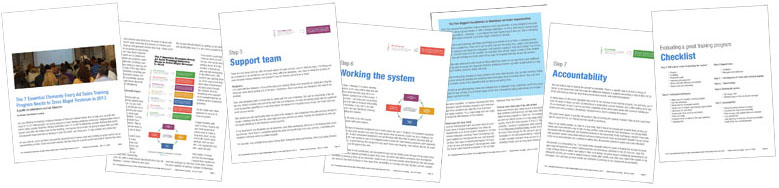
If you read our free e-book "The 7 Essential Elements Of Successful Ad Sales Training Initiatives", we've become convinced that working the system and the ad rep's accountability make the difference between a newspaper that generates $100,000 in the short term and finishing the year at over $1 million in added revenue.
In fact, these two final steps (see steps 6 and 7 in the infographic at right), as explained in detail in the last couple of chapters of the e-book, make such a huge difference that we've decided to help out busy ad directors with the day-to-day implementation of these steps throughout the year, too.
Now, when we work with a newspaper, we first pick a number of target accounts from the start, usually totaling anywhere from $500,000 to $3 million. We call them the "Dream 50" or "Dream 100".
Then, once the initial training is completed (through step 4 in the infographic at right), we provide complete presentations for a large number of them immediately along with specific coaching videos on how to sell that particular ad.
Most importantly, as most of our very successful clients have been doing, I meet with the ad reps often throughout the year, ensuring they're presenting properly and troubleshooting with them if they aren't selling.
We're completely honest with the ad reps if they don't yet have the presentation down or aren't following the steps correctly and we hold them accountable. It's where many newspapers drop the ball, and it's tough to blame them. On the whole, I find in this new world of newspapers, most publishers and ad directors just have too much to do and too little time.
This process, which can be applied to any training program, is all explained in my e-book without any big sales pitch for us.
If you want a closer look at the infographic in this post, here's the full-size version. You'll also see a place where you can download the free document.
Tuesday, December 18, 2012
Free E-book: "The 7 Essential Elements Every Ad Sales Training Initiative Needs to Drive Major Revenue in 2013"
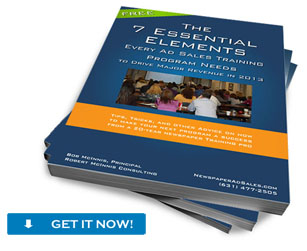
Creating a training program or hiring an outside training firm to help your ad staff sell more in 2013? I've just written a 25-page FREE e-book that explains how to ensure your next initiative will drive some major revenue fast and keep doing so for years--whether you make one yourself or hire someone like me.
I've dedicated much of my life to delivering ad sales training that sticks around long after the trainer has left the building and have learned some tricks that can generate huge amounts of revenue in both the short- and long-term.
Much of them are based on watching the 1,000+ newspapers I've worked with, identifying those that end up driving almost unheard of revenue from my course, and seeing exactly what they're doing differently. Surprisingly enough, the things they do are relatively easy, don't take a whole lot of time and effort, but make a huge difference.
Some you know already, like the need for a great course and trainer.
But there are other, less obvious ones that’ll really determine the amount of revenue your program will generate and for how long, especially if you use a training company willing to help you every step of the way (which is definitely something we recommend looking for).
These newspapers have figured out that the secret to making any training program drive major revenue is to follow 7 essential steps that are both easy and powerful.
Each step can make the difference between an initiative bringing in $100,000 total and one bringing in that amount every single month. In fact, some tips that I've recently discovered are so monumental (in the "working the system" and "accountability" areas) that I've decided to do these things for my own clients next year.
So, I've put these steps together in a free, 25-page e-book to share these secrets. They'll ensure your next training initiative--either your own or one you bring in--is an unprecedented success.
You can view and download the free e-book here: Download 25-page e-book
Subscribe to:
Posts (Atom)